
I thought of you draining 22k from your business…
I thought of you draining 22k from your business…
"I don't have enough hours in the day to choose effectiveness over efficiency."
Surprise surprise, AI hasn't fixed our problems with email. And so often, the important work clients want to do with me is blocked by this pesky tool.
From data I've gathered over the past 3 years, my mentoring clients, whether they be business owners or managers, they are spending an average of 2 hours per day on emails. And many keep it open all day with constant checks. It hurts my heart because I know the cost of this on you, your team and your business.
Here’s the ripple effect of email ruling your life (and business):
Cognition - Gloria Mark's research out of UC Irvine (the one Cal Newport leans on in Deep Work) found it takes over ~23 minutes to fully regain focus after a switch. Every "quick check" of your inbox is a switch. Do the maths on how many of those you're doing in a day, and cognition, productivity, accuracy, motivation and focus are all impacted.
Profitability - I will strongly argue that most people in business are spending at least 1.5 hours too many in email per day. If that's a practice managers efficiency we're tracking, that's a 22k* cost to your business annually. And for some, it's easily more than this.
Business by design - email bleeds into your personal world, you lose boundaries and overtime you lose sustainability and put things at risk of burnout and relationship strain.
Client experience - sending 5-8 emails that could have been 1 or 2? You're passing the buck of mental load onto your clients when they are already overloaded, like you.
Sales probability - if you're reliant on an email only sales process, you're slowing down your pipeline, and increasing the chance of being ghosted, which seems to be an unwanted trend right now. A saw a recent poll on Linkedin where 90% of people reported being ghosted recently.
(Yes, I see the irony that this blog is landing in your inbox)
The AI "Promise"
The early promise of AI on email has focused on speed — faster triage, faster replies. Speed is the wrong goal.
ActivTrak's 2026 State of the Workplace report tracked 443 million hours of work activity across over a thousand companies. Comparing the 180 days before and after AI adoption, in a group of over 10,000 employees, email activity went up 104%. Not down, and to top it off chat and messaging went up 145%.
(I want to go hide in the pantry at this point)
AI didn't reduce the inbox load, it fed it more content. Are you surprised?
When one person uses AI to draft faster, it's not neutral for whoever's on the other end. A three-line email becomes an four-paragraph one, generated in twelve seconds, and now the person receiving it has to hunt through it for the one useful line.
The sender was being efficient, but not effective, because the receiver has inherited the additional mental load, translation and filtering.
There's a second cost sitting underneath that one. Email triage via AI is a super handy tool, but it dilutes the connectivity to the relationships and practice movement for business owners and managers alike.
Efficient and effective are not the same thing
Checking email one - three times a day, in intentional chunks, and sticking to it is where I see the magic happen.
Sending one email instead of four, because you took the extra ninety seconds to ask yourself have I given enough information that this only needs one reply, that's effective.
In the rush or haste to be efficient, we lose effectiveness.
We punch out replies, tick the box, feel productive. But ticking something off isn't the same as it having an impact, and impact is what effectiveness actually measures. AI is extremely good at making us faster. It’s up to the human intention and communication skills to be effective. If anything it's made the gap between the two wider, because now we can produce more low-impact communication per hour than ever before.
It’s more than a systems problem
We check email too often for a few reasons, but addiction is the biggest factor. Notification sounds were designed the same way pokie machine sounds were designed. Noise > dopamine > visual cue > repeat, until eventually you get the dopamine hit just from seeing the notification with no sound at all. Feels gross doesn't it?
The other reason is boundaries, or the lack of them. If you’re constantly available and in service, this gets exploited, not usually on purpose, by people who notice we don't push back. Once someone learns you'll drop what you're doing to respond, they'll keep asking you to.
Email makes the small things convenient and the big things distant. Businesses lose perspective on their true priorities as a result, and constant reactivity is where you land and it feels freakin heavy.
Every time you're reactive to what's sitting in your inbox, because it's right there and it's easy, your true priorities get pushed further down the line. And for business managers specifically, holding the big proactive picture while your leader has ten new exciting ideas a week, means an inbox is minimising your ability to do this effectively.
Boundaries are the number one thing I see dismantle a talented human. With no boundaries around their attention, they will eventually burn through the very thing that makes them special, or human.
It's not all grim. What I'd invite you to try:
Time block it. Decide when you're in your inbox and when you're not, and treat the gap like an appointment you keep with yourself. I suggest 2 blocks of 30min per day.
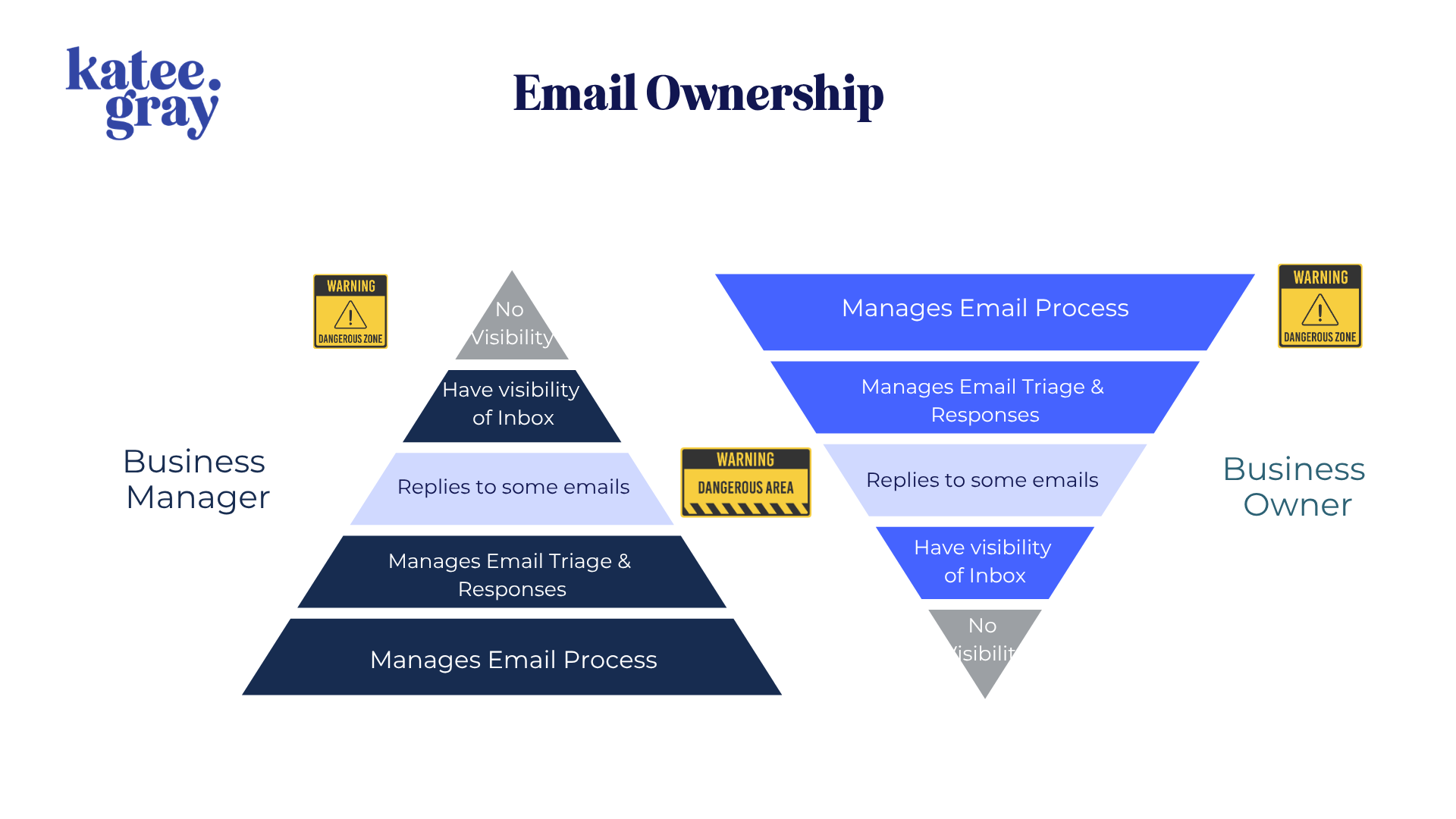
Have clear ownership. If you have a team, be sure that email process ownership sit’s in one persons lane. I see a lot of cognitive and practical drain from teams who sit in this murky middle ground of email ownership:
Filter on the way through. Anything that'll take more than five minutes gets pushed straight to your task manager, scheduled for a time block. What's left in the inbox should only be thirty-second to five-minute replies. Spend the first half hour of your day on the important / urgent category, then move into your planned day.
Take the urgent stuff off email entirely. If something's genuinely time-sensitive, it shouldn't be sitting in an inbox waiting to be checked. A phone number in your signature, a direct text, or a phone call. Email is for what can wait, we have seriously lost the art of a quick phone call and it's costing us.
Get some physical friction. If your phone is the thing pulling you back in every ten minutes, a tool like Brick puts an actual physical step between you and the apps you can't leave alone. Tap to block, tap to unblock. Ideally, don't have email on your phone at all.
Get better at asking for the sale directly. In the room or on the call, instead of leaning on an email thread to close it. And mindfully consider where your sales experience could do with more human touch.
Slow down, think deeper. Before you reply to anything today, ask one question. Have I anticipated what they'll need next, and included it now?
Client experience: Would that program that goes for 12 months for an organisation be better supported by an onboarding client support call to align calendars, instead of 30 back and forth emails?
Have you communicated to your clients HOW and WHEN to best communicate with you that reduces email load for both of you?
Often what looks like an email problem isn't an email problem at all. This recent client case study is a great example of how beliefs and patterns can be running the show, but on paper it seems like you need a new system / CRM/ triage method etc.
If you want to figure out what's sitting underneath what’s draining you, I’d love to chat. You can book a pick my brain call below.
I REALLY hope this shifts the way you work with email, I’d love to hear how you get on.
Katee
Ps. Here’s the background calcs of the 22k cost;
1.5 hours a day lost to email that are better served on client experience/ projects / sales activity that keep you in proactivity
Practice manager costs average $60 per hour
1.5 hours per day, 5 days per week, 50 weeks of the year = 22k per year
Now imagine that’s YOUR time and attention as a business owner… What’s the opportunity cost?
