
When to use AI in your practice and when to leave it alone
When to use AI in your practice and
when to leave it alone
2026 has brought significant change, some I’m loving and some of it is exhausting. Last year, AI was enhancing the role of a virtual assistant (VA), business/practice manager (BM/PM), or Executive Assistant (EA). This year it's completely changing how the role works and how I'll recruit and hire going forward.
The practice manager role is still imperative, I don’t feel the same about virtual assistant roles unfortunately. The practice manager's primary goal is protecting your energy so you can bring your best ideas, deliver your best with clients, and build a solid sales pipeline. That hasn't changed. What has changed is what that protection looks like.
AI is absorbing the task-heavy, execution-heavy, administrative side of the role. That can be a GREAT thing if you approach it strategically. On paper, some people think this means the role is smaller, but really it’s taking up space in a different domain of the role. The most important domain for your current or future practice manager to be leaning into is client communications and retention, business development activity, sales pipeline management and supporting your energy management.
This two part series is for business owners and practice managers. Whether you have a PM, are thinking about hiring one, or you are the PM, I thought of you…
Where I’m seeing businesses trip up with integrating AI to support their administration and operations.
Before we define what does live in the PM role, and what could be outsourced to AI, you need to step back and create two foundational pieces. If you skip these you'll create noise (perhaps you already have) not effective processes, and spend months untangling it.
1. Get clear on your values and ethics around AI
Just because you can, doesn't mean you should.
In a business built on thought leadership, you trade on trust, relationships, and intellectual property. Before handing anything to AI, you need a clear framework for what it can touch, execute, and automate and what stays human.
The question isn't "can AI do this?" It's: what level of AI involvement is consistent with my brand, my relationships, and my integrity? Then run it through two filters;
Filter 1: Written content
Thought leadership is built on your ideas and IP. This is where the strongest AI parameters belong. AI can help you explore or refine an idea, but it shouldn't be writing for you. Insert into your Project instructions: Help me think, don't think for me.
For everything going out under your name, here are suggested content types to discern;
Client communications (relational)
Client communications (transactional)
Responses to difficult situations (internal and external)
Content published - blogs, social media, PR etc
Repurposed content
Proposals and Contracts
Referral touch points
Slide decks
Map each content type against these levels:
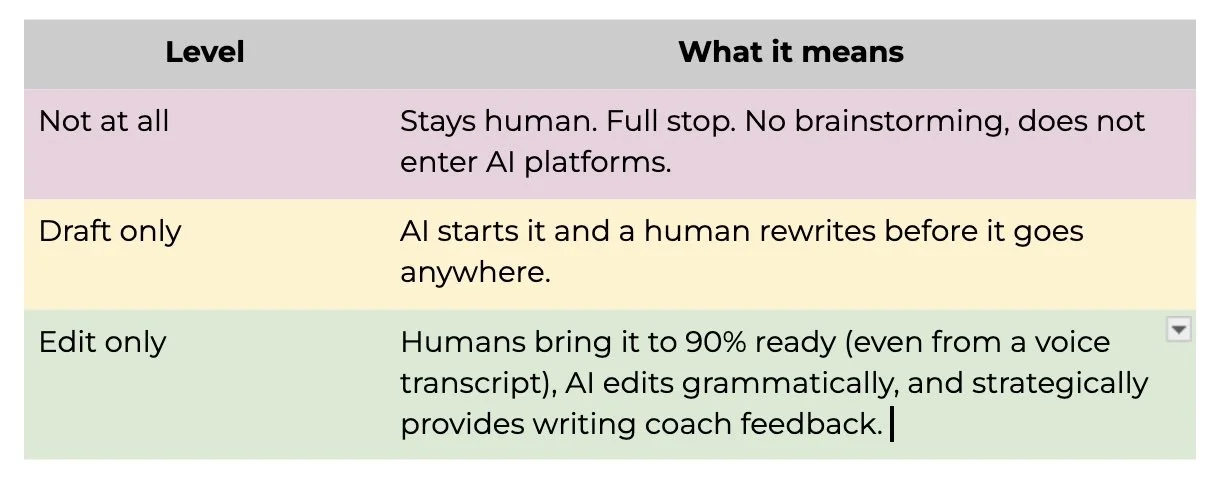
Filter 2: Processes & Automation
This is where most practices start their AI implementation, less about voice, more about getting out of the weeds. But human checks still matter to catch errors, gaps and relational opportunities.
Process categories to consider for automation & AI:
Financial transactions/ reconciliation or reporting
Calendar management - bookings or capacity review
Email triageMarketing follow up/ lead generation
Graphic design / Social media creation
Session notes - summaries/ or prep
Session or Podcast recordings, chapters, transcription and publishing
Meeting and Task summaries / agenda prep
Reporting / Weekly or monthly business summaries
Then Map each process type to your AI principles;
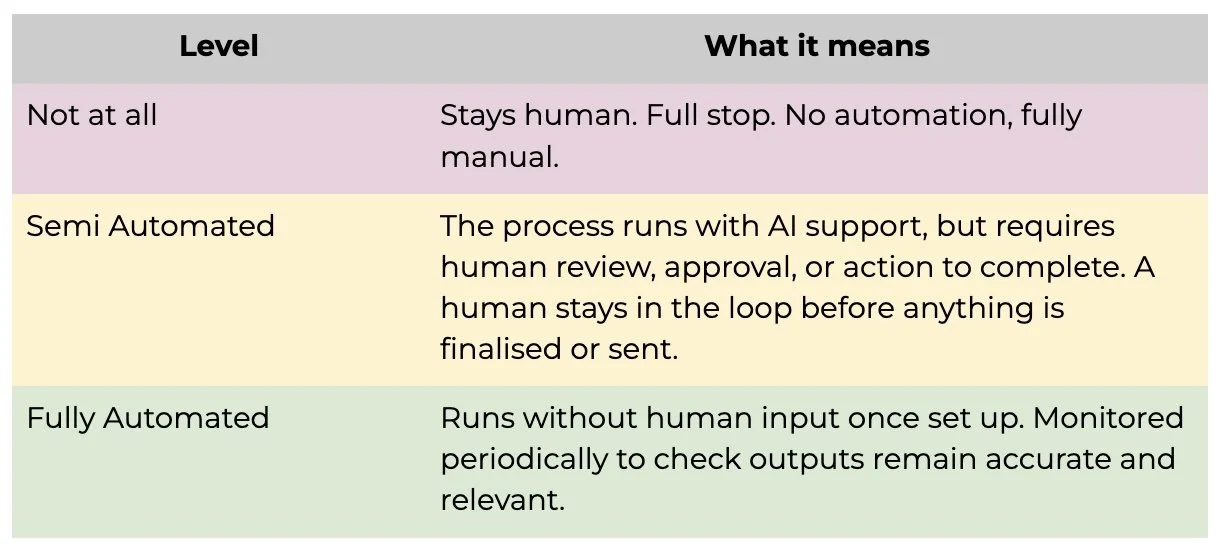
CRITICAL NOTES:
A: PRIVACY: Never upload documents or data that includes sensitive or confidential information. Seems self explanatory but can happen easily. Examples;
Your TFN (Tax file number) or your team
Bank account details
Passport details and/or Drivers License
Payroll details
P&L statements
Passwords
API’s
Unpublished IP
Legal documents or anything that falls under client confidentiality
Client details such as names, email, phone, health or financial info.
B: BACKUP & DIVERSIFY
While It can be tantalizing to have Claude be your CRM, your calendar, your bookkeeper, your copywriter etc, this does not protect your future of business sustainability or data. As we saw recently, everyone got themselves excited and setup of Claude code, and them boom, overnight prices shot up and plans changed.
Don’t set yourself to be in a controlled relationship with AI. Ensure you have monthly processes embedded for;
Backup writing / data / designs (Do this not just for your AI system, but your CRM list, and files)
Keep a master version of your project knowledge and instructions in a separate home to your AI system
2. Sequence by impact, not excitement
Before mapping an AI implementation plan, get honest about what's draining your time, energy, and/or your bank account.
What lands in your inbox and makes you sigh? What drags you into the weeds when you should be doing your highest value work?
Then sequence what you implement based on impact, not what's easiest or most exciting to automate. Start where the return is greatest, then use the capacity that is created to fund (with energy, time or money) the next piece of implementation.
The goal isn't to automate everything. It's to free up more hours for client experience, relationship-building, pipeline movement, and strategic thinking.
Most AI tools can do something useful, and it’s damn tantalising at times. Fast-brain creatives will find a reason to say yes to most of them.
The question worth asking: does this belong in my business right now? And does saying yes mean saying no to something that matters more?
Sequencing requires subtraction. Factor in the real cost of implementation, researching, testing, embedding, writing new processes. This foundational work pays dividends.
Coming up next in Part 2 I’ll cover the skills and traits that matter most now for a practice manager now that AI is dominating the level of noise out there - to support a role review or future hiring.
Before you go
If you already have a business / practice manager, your current position description is most likely overdue for a review. This could be part of a performance review or stand alone, as a conversation about what the role looks like in 2026 and beyond.
Do the foundations work first. Know what you're asking the role to become before you sit down to discuss it.
I've built a position description template specifically for the future of the practice manager role in a thought leadership practice, integrating AI capability throughout, and including role review prompts to support a collaborative conversation with your existing practice/ business manager.
And I’ve included a pay rates guide as a bonus for you too.
Till next time, (and Part 2 coming next - How AI has changed the Practice Manager role)
Katee
