
Your dry pipeline checklist
If you're looking ahead to 2026 and feeling some dread around the lack of activity in your pipeline, often the first instinct is to do more. More emails, more posts, more outreach. More connections. New offers.
I get it. When sales activity slows down, panic can set in and we run on default.
Most expert led businesses aren't suffering from a content volume problem though. They're pouring energy into a system that has a leak that has likely gone unnoticed, until now. Or they're speaking to the wrong problem entirely, and no amount of activity will fix that.
So before you exhaust yourself or expend resources - let's get clarity on where your pipeline is leaking.
The Dry Pipeline Checklist
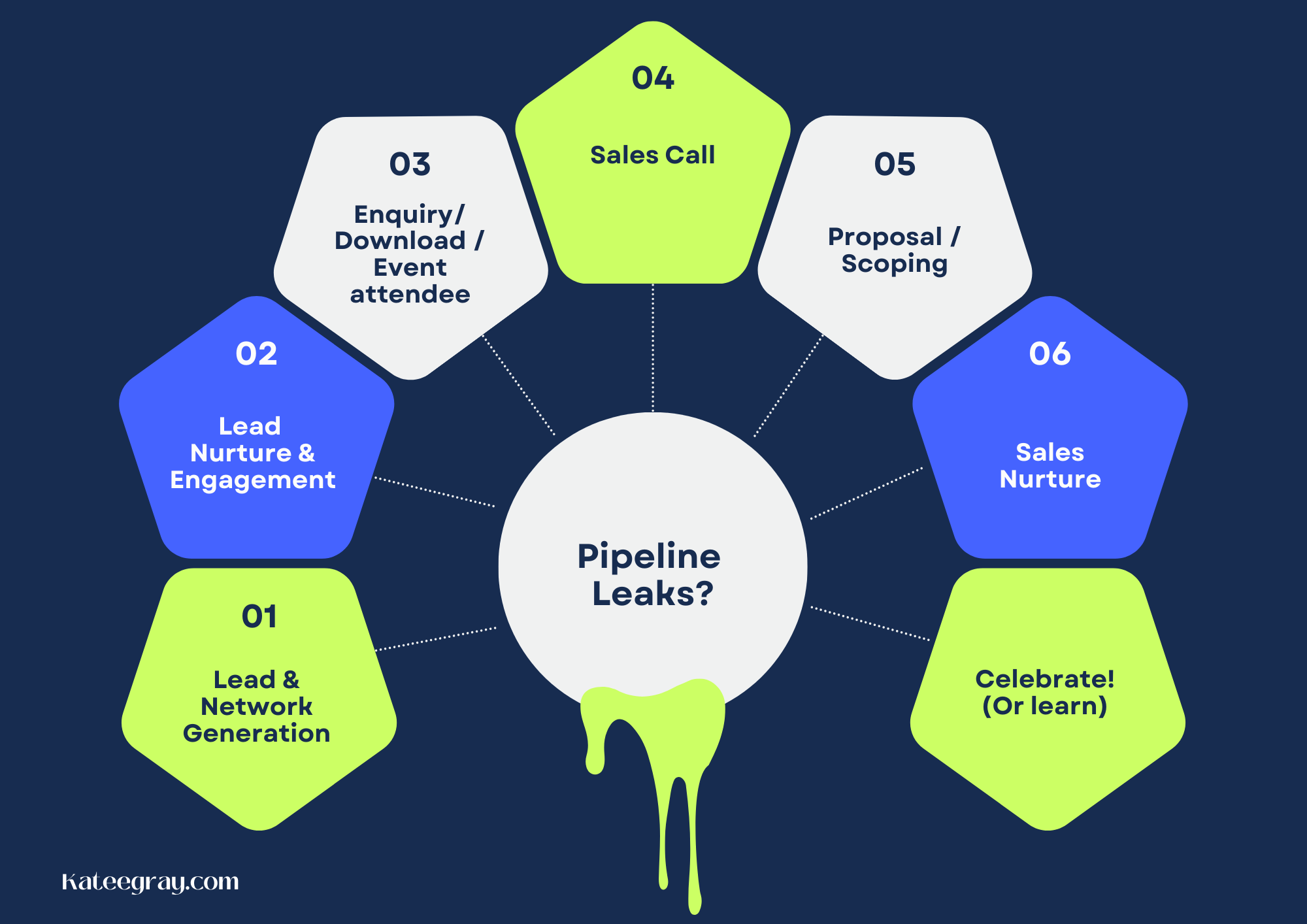
01. Lead & Network Generation: Is your list growing?
Check your list growth patterns, do you need more people in your world? Focus on value led content, speaking opportunities, podcast interviews, collaborations and diagnostics. Get known by the right people.
Worth looking at: Google Analytics for landing page performance. High bounce rate + low time on page? Your headline might be attracting the wrong people, or your content isn't holding attention. Make becoming a subscriber deeply compelling.
But before you build more content, check: Is this speaking to what your buyers actually care about at this given moment in time?
Most experts create resources for participants (people sitting in your workshops) when they need to attract buyers (people who hire you). A corporate L&D buyer doesn't care so much about your facilitation framework (The how) - they care about reducing onboarding time or improving retention (The why).
If your list isn't growing, it might not be a visibility problem. It might be that what you're offering doesn't speak to pain worth solving.
02. Lead Nurture & Engagement: Are they opening, clicking, and taking action?
Start with deliverability - domain authentication, sender reputation, spam triggers and those boring (and important) things. If your emails aren't landing in inboxes, nothing else matters.
Once that's clean, look at your open rates and audience fit. Are you emailing the right people? If you've been growing your list through free resources aimed at participants but trying to sell to buyers, this will have flow on effects.
And check your subject lines - is it what they'd be typing into Google at 2am? Or is it your language, your framework, your clever positioning?
If people are opening but not clicking through, they're confused or unconvinced. This is where most experts discover they've only scratched the surface of their market's problems. You're likely naming the surface issue - better team communication, more effective meetings, leadership development. But you're not drilling down to what they're actually feeling, seeing, and thinking.
If your click-through is low, you might be solving yesterday's problem or speaking in language that sounds like everyone else.
Worth looking at: Google Analytics - landing page time on page and scroll depth (last 8-12 weeks). If they're bouncing quickly or not scrolling past the first screen, they're not finding what they expected. If they're scrolling all the way down but not converting to an event or download, your offer or CTA isn't compelling enough.
And watch for the buyer vs participant language shift. If your landing page talks about transformation, growth, or empowerment (participant language), but your buyer cares about retention, revenue, or efficiency (business outcomes), you’ve just found another leak.
03. Enquiry/ Events / Webinars: Are they registering and showing up?
Cover the basics: Ensure your system includes an “add to calendar” feature and session/ booking reminders to improve show rates. But don’t be generic, remind them of the WHY and WHAT in your reminder emails - and make it unique to your voice and brand. Every touch point is an opportunity to strengthen the future relationship.
If your show rate is terrible, check: did they register because the topic sounded interesting, or because it spoke to an urgent problem they need solved right now?
"Interesting" gets a registration. "Urgent" gets them showing up.
You might be attracting people who are curious but not in pain. Or you attracted the participant (interested in learning) instead of the buyer (needs to fix something this quarter).
04. Sales Call: Are event attendees booking calls?
If your show rate/ click rate is good and people are engaged in your events or collateral, but not booking sales calls afterward, ask yourself: are you making the path to working with you clear and frictionless?
Some experts end an event without a clear next step and invitation to work together. Make the CTA clean and clear right from the start, an invitation to be in each other's worlds.
If attendees aren't converting to sales calls, either the event didn't surface their real pain point, or you didn't make it clear what happens next.
The event should do two things: demonstrate your expertise AND create clarity around the cost of not solving this problem. If you're only doing the first part, you'll get thanked but not booked.
05. Proposal/Scoping: Are sales calls converting to proposals that sell?
Let’s say you’re having lots of great sales conversations. But proposals are going out and getting ghosted, or getting a "we'll think about it" that turns into silence - something's misaligned.
The most common leaks at this stage:
You're scoping to what they asked for, not what they actually need. They came to you asking for facilitation training when they actually need a complete learning strategy redesign. If your proposal only addresses the surface request, they'll stall.
You're not quantifying the cost of inaction. A good proposal makes it clear what it costs them (in time, money, team morale, missed opportunities) to NOT solve this problem. Without that, your proposal is just an expense, not an investment.
You’re addressing the WHAT and the HOW, but missing the WHY.
Worth looking at: Proposal acceptance rate over the last 6 months. If it's below 30%, you're either talking to the wrong people or your proposals need an overhaul. If it's above 80%, you might be underpricing or only working with the easiest fits.
If proposals are stalling, go back to your discovery process. Are you asking the right questions to surface urgency, budget, and decision-making authority? Or are you pitching to someone who can't actually say yes?
06. Sales Nurture: Are they moving from proposal to close?
Are you missing out on opportunities due to a lack of follow up? Or slow response time? It’s a busy and cluttered world out there - and it takes concerted effort to stay visible with your audience.
Be clear in your proposal what the next steps are so they can expect a follow up from you, and need to know the next steps within their organisation to get to a decision. Without this knowledge and agreement, your sales process will drag out or fizzle out.
07. Celebrate! (Or learn)
Whether you celebrate a new client or commiserate in another ghosting, you're gathering data.
The goal isn't to convert 100% of your sales conversations. The goal is to know where your pipeline is leaking so you can fix it systematically instead of just doing more.
More activity won't save a message that doesn't resonate.
Fix the leak first. Then turn on the tap.
Did this help you identify a potential leak? I’d love to hear about it….
Katee
Psst. If you need help figuring out where your leak actually is - this is exactly the kind of thing we can work through together - let's book a chat.

Not subscribed yet?
For solopreneurs who value brain space over busy-ness
Running a business shouldn't cost your sanity.
Each edition delivers carefully chosen insights to help you:
Streamline processes that save precious time
Shift mindsets that preserve vital energy
Simplify communication that cuts through complexity
Whether you have a team or you're flying solo, I meet you where you are with practical options you can implement today, this week, or this quarter.
Unsubscribe anytime. I believe it should be just as easy to exit as it is to enter.